
Let me start with something you already understand. When someone tells you the Sensex jumped 600 points this morning, you immediately know what that means - without looking up a single company. The index does all the work. It takes thousands of individual price movements, compresses them into one clean number, and tells you, in a single breath, which direction the whole market is heading. Useful. Simple. Powerful. Now here is what most people do not know: fine wine has the exact same system. It is called Liv-ex. Its indices are the Sensex, the S&P 500, and the FTSE 100 of the bottle world — and once you learn how to read them, the fine wine market stops being a mystery and starts being a market you can actually understand.
What Is Liv-ex - and Why Does It Exist?
Liv-ex: the London International Vintners Exchange; is the global professional marketplace where fine wine is bought and sold between merchants, investment funds, and serious private buyers. Think of it as the London Stock Exchange, but every listing is a wine rather than a company. Every transaction that takes place on Liv-ex is recorded, priced, time-stamped, and published. That data feeds directly into a series of indices - benchmarks that track how different parts of the fine wine market are moving over time.
Think of it this way The Sensex tracks 30 of India's most important companies. The FTSE 100 tracks the 100 biggest companies listed in London. Liv-ex indices track the most actively traded, investment-grade wines in the world. Same mechanism, entirely different asset. One tells you how Reliance and HDFC Bank are performing. The other tells you how Chateau Petrus and Domaine de la Romanee-Conti are performing. Both are doing exactly the same job - turning a sprawling, complex market into a number you can actually use. |
And just like stock markets, wine indices are broken down into segments. There is not just one number. There are several, each covering a different slice of the market- from the most focused blue-chip benchmark to the broadest global view. Knowing which one to look at, and what it is telling you, is half the skill of reading a wine market update.
The Four Indices You Need to Know
These are the ones quoted in every serious wine investment report. Read each one the way you would read an equity index - as a specific, purposeful lens on one part of the market.


Beyond these, there are regional indices for Burgundy (the Burgundy 150), the Rhone Valley (the Rhone 100), Italy (the Italy 100), and California (the California 50). Each works identically -a basket of that region's most actively traded wines, aggregated into a single moving number published monthly and compared year-on-year.
How Is an Index Actually Calculated?
This is where it gets interesting - and this is also what makes Liv-ex fundamentally different from a wine magazine's price guide or a retailer's price list. Every movement in a Liv-ex index is driven exclusively by real, completed transactions. Not estimates. Not opinions. Actual bottles changing hands at actual prices between actual buyers and sellers.

How Is This Different From Just Googling a Wine Price?
This is precisely the right question - and the answer is what makes wine indices genuinely useful rather than just decorative. When you search a wine's price online, you see what one merchant is currently charging for it, in one market, at one moment. That is like checking a single stock's price without knowing whether the whole market is up or down, whether buyers are outnumbering sellers, or whether trading volume is rising or collapsing.
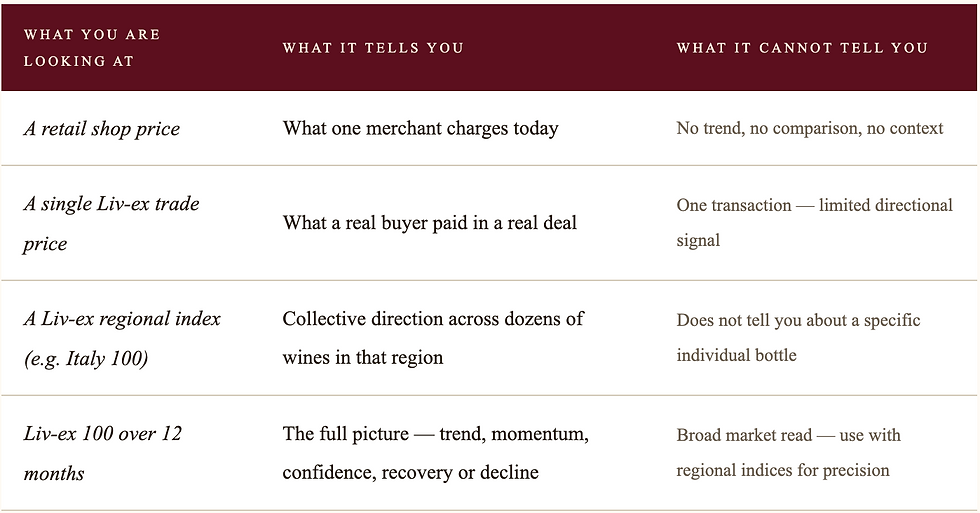
The indices give you context that a single price can never provide. When you know that Sassicaia 2021 is trading at £2,416 per case, that number is interesting. When you know the Italy 100 index is up 0.8% in Q1 2026, that Tuscany has held its position as one of the top-traded regions for three consecutive years, and that US buyers are specifically targeting Italian wines in April 2026 - that £2,416 has a story behind it. A compelling one.
An index does not tell you which bottle to buy. It tells you whether the cellar door is open or closed. Right now, for fine wine, it is open. |
The Liv-ex 100 recorded six consecutive months of growth through Q1 2026. That single data point tells you something important: it is not that every wine went up. It is that the direction of the market - as measured by real transactions across the 100 most traded investment wines in the world- is unmistakably upward. The index is not the investment. It is the map. And now you know how to read it. |
-The Bottom Line The Index Is Not the Investment. It Is the Map. Wine indices do not tell you which bottle will double. What they tell you is whether the territory you are navigating is rising or falling, which regions have momentum this quarter, and whether the people with serious money are buying or waiting. That context- that map -is what separates confident wine investment from expensive guessing. The Liv-ex 100 is your starting point. The regional indices - the Bordeaux 500, the Champagne 50, the Burgundy 150 - are your zoom-in tool. Use them together, read them over time, and the fine wine market stops being an opaque world of labels and vintages you feel you need a degree to understand. It becomes a market. And markets, once understood, can be navigated with real confidence. |
This article is for educational purposes only and does not constitute financial advice. Prices mentioned in the articles are for illustration purpose only.
Comments