
We have all heard the pitch. "Treat your wine collection like a stock portfolio." It sounds sophisticated, doesn't it? You picture yourself tracking tickers for a 2018 Bordeaux, watching a live chart of Napa Valley Cabernet the way you watch the Sensex on a Monday morning. On the surface, the comparison makes sense. Both involve putting money into an asset today in the hope it is worth significantly more tomorrow. Both have blue-chip names - think Apple and Microsoft versus Domaine de la Romanee-Conti or Chateau Petrus.
But here is the truth nobody tells you at the wine tasting: if you try to manage a cellar using the same rapid-fire logic you use on a trading app, you are going to end up with a very expensive collection of vinegar and a whole lot of frustration. Let us pull the cork on exactly why these two markets are fundamentally different - and why those Buy, Hold, and Sell signals from your monthly stock charts are virtually useless in the world of fine wine.
The Core Difference
The Nature of the Asset: The Infinite vs. The Finite
To understand why these markets cannot be managed the same way, you first need to understand what you actually own in each one.
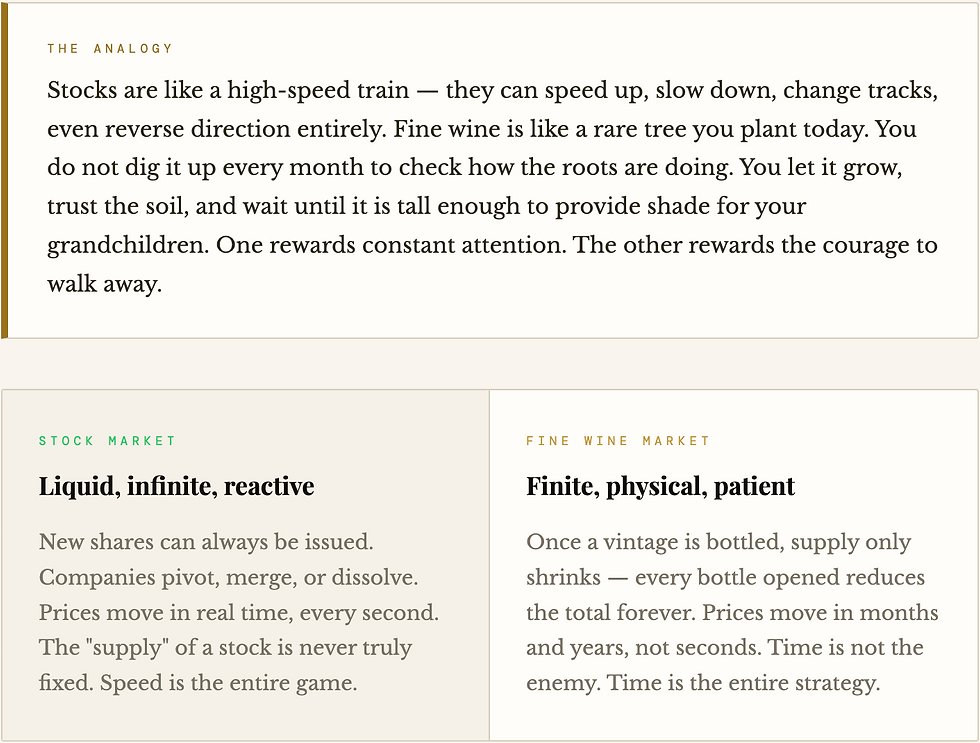
The Stock Market: The Infinite Machine
When you buy a share of a tech company, you are buying a piece of a living, breathing entity. That entity can hire new people, launch new products, pivot its entire business model, or issue more shares tomorrow. Stocks are fundamentally liquid and infinite in nature - you can sell ten thousand shares of a major bank in seconds with a single click. Markets react within milliseconds to a tweet, an earnings number, or a central bank statement. It is high-energy, high-speed, and by design, high-stress.
The Wine Market: The Time Capsule
A bottle of investment-grade wine is something categorically different: a physical, wasting asset. Once the grapes are harvested and the wine is bottled, that is it. There is no second edition. There is no CEO who can announce a restructuring and change the outlook. You are holding a finite object that is slowly, irreversibly evolving toward its peak - and then, one day, someone opens it and it is gone from the market forever.
Where Traders Get It Wrong
Why "Monthly Signals" Fail the Cellar Test
In the stock world, traders live by three rules derived from monthly charts: Buy the dip, Hold the trend, Sell the peak. Clean, logical, battle-tested. In the wine world, applying these same rules is like using a weather app to predict a cricket score. The data exists. The logic sounds plausible. But the two things operate on entirely different laws.
Rule One: "Sell the Dip" — The Scarcity Inversion
In stocks, if everyone sells, price drops because supply floods the market. In fine wine, the opposite force is quietly operating beneath the surface. When someone "sells" an investment wine, it almost always means a buyer somewhere pulled the cork and drank it. The total supply of that vintage just decreased - permanently. If your monthly chart shows a dip and you sell your case of 2005 Bordeaux, you may find it impossible to buy it back. There is no warehouse printing more. The "sell the dip" reflex, so useful in equities, works against you here.

Rule Two: "Monitor Monthly" — The Dead Zone Trap
Here is something that would drive a day trader to madness. A great wine might sit at exactly the same price for three consecutive years. No movement. Flat. Dead. On a stock chart, this is a signal to exit -dead money, opportunity cost, capital deployed elsewhere. But in wine, this plateau is not stagnation. It is the calm before the leap. A wine approaching its "drinking window" - the optimal age for consumption - can jump 30 to 40% in a single year, almost overnight, as collectors around the world simultaneously recognise that now is the moment. If you followed the monthly "Hold" signal out of boredom and sold in year two of that flat period, you missed everything.
Rule Three: "Buy/Sell on Signals" — The Human vs. the Harvest
Stock signals are built on human behaviour - earnings, sentiment, interest rates, geopolitics. They respond to decisions people make in boardrooms and trading floors. Fine wine does not care about any of that. Its performance is dictated by chemistry and time. The tannins are softening. The fruit is integrating. The colour is deepening. No quarterly report accelerates or delays this. You cannot short a great Burgundy. You cannot call a vintage meeting and change the numbers. Nature set the outcome decades ago; the market is just slowly catching up to what the bottle already knows.


This article is for educational purposes only and does not constitute financial advice.
Comments