Updated: Aug 21


Let me set the scene for you. In the first quarter of 2026, a war broke out in Iran. Oil markets spiked. Global equity markets wobbled. Central banks hinted at interest rate rises. Investors sat anxiously watching portfolios fluctuate - some losing sleep over what the next headline might do to their holdings. And fine wine? Fine wine held steady. The Liv-ex 100 - the benchmark index that tracks the 100 most traded investment wines in the world - closed Q1 at plus 0.2%. Not a crash. Not a panic. Steady.
I have been through the Vin-X Q1 2026 Market Report carefully, and I want to walk you through it the way I would explain it to a friend over dinner - no jargon, real numbers, relatable comparisons. By the end, you will know exactly what happened in this market, which wines won, which stumbled, and whether any of it should change how you think about your money.
-Section 01
What Is the Liv-ex 100 and Why Should You Care About 0.2%?
Think of the Liv-ex 100 exactly like you would the Sensex or the FTSE 100 - except instead of tracking the top companies, it tracks the 100 most actively traded investment wines on the global market. When it goes up, fine wine as a whole is appreciating. When it drops, prices are softening.
Now, the Q1 2026 result was +0.2% overall for the quarter. There was also a dip of -0.3% in March specifically - the first negative month since August 2025. That sounds alarming at first. It is not. Here is why.

Here is the number that matters more than that -0.3%: relevant bid exposure-essentially the total value of buyer orders sitting in the market - rose 34% above its Q1 2025 level by the end of March. Buyers were not retreating. They were leaning in. More money chasing the same or fewer bottles. That is the setup for price growth, and it is quietly happening right now.

-Section 02
The Wines That Won: Double-Digit Returns in a Nervous Market
While global markets fretted, certain wines delivered returns that would have made a fund manager take note. The top five performers in Q1 2026 were led, surprisingly, not by Bordeaux's famous First Growths, but by the Rhone Valley - a region that has quietly been the strongest performer for months.

Let me make those percentages tangible. Say you invested £10,000 in a case of Chateau Rayas CNDP 2008 at the start of Q1. By the end of March 2026, that position is worth approximately £14,030. A gain of over £4,000 in three months -on a physical asset sitting in a warehouse, not a screen.

Three of the top five were Rhone wines. Two were from Bordeaux - specifically, the 2013 vintage, which keeps appearing in the data as a quietly exceptional year that the market is only now fully recognising. Chateau Troplong Mondot 2013 was up 19.9% in March alone and 30.8% across the quarter. Chateau Grand Puy Lacoste 2013 gained 28.0% over Q1. Both are Bordeaux. Both are 2013. Something worth noting if you are building a portfolio.
-Section 03
What Was Being Bought: The Most Traded Wines by Value
Trading activity tells you where real-world confidence sits -not just where prices moved, but what buyers were actually willing to pay for right now. In March 2026, the picture was dominated by something that would have surprised most people: American wine.

Five of the top ten most traded wines in March were American. Screaming Eagle took two of the top three spots. Opus One appeared three times across three different vintages. US wine trade share on Liv-ex spiked to 10.2% in March - the highest since January 2022, deep in the bull-run peak period. This is not a coincidence. A stronger dollar is making it attractive for American buyers to purchase their own iconic wines through London at what amounts to a relative discount. When a market's native buyers start buying through a foreign exchange, you know confidence has genuinely returned.
-Section 04
Region by Region: Who Gained, Who Slipped, and Why
The report covers every major fine wine region. The picture is nuanced -no region had a catastrophic quarter, but the performances varied considerably. Here is the honest breakdown.

Where did things dip — and is it a problem?
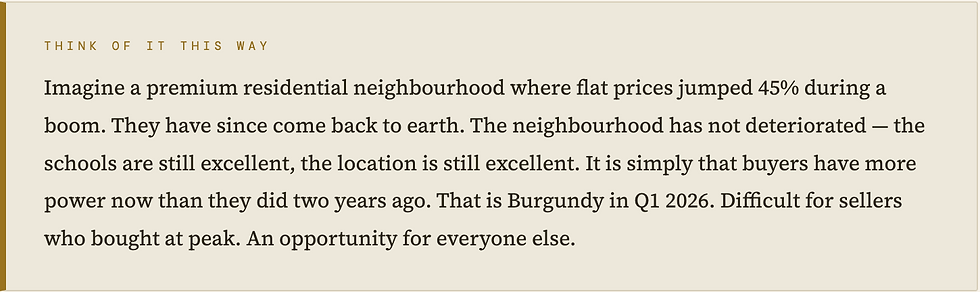
Burgundy at -0.6% and California at -0.8% were the two regions that softened. Let me give you perspective on both. Burgundy's dip reflects a market that surged hard in 2021 and 2022 and is now settling to a more sustainable level - the fancy term is "price consolidation." The underlying demand is there: Asian and US buyers are specifically targeting Burgundy because of its historically low current prices relative to quality. Dom Comte Georges de Vogue Musigny 2019 was up 16.2% in March. Clos de Tart 2019 gained 11.1%. The index dipped; specific bottles flew.
California's -0.8% tells a similar story with a twist. The index was soft, but the momentum data in April 2026 completely reverses that narrative. US wine trade share spiked to its highest level since the 2022 bull run. A stronger US dollar makes these wines cheaper for American buyers purchasing through London. Screaming Eagle and Opus One are being actively targeted. What looks like a quiet Q1 is potentially the calm before a sharp move upward in Q2.
-Section 05
The 5-Year View: Where Patient Investors Were Rewarded
The quarterly numbers are interesting. The five-year numbers are where the real story lives. This is the timeframe that genuinely separates fine wine investment from speculation, and the data across every region makes a compelling case for patience.

Domaine Bonneau du Martray Corton Charlemagne 2013 has more than doubled over five years at +126.7%. Two other Domaine Leflaive wines crossed the 100% mark. Let me make that real for you: £15,000 invested five years ago in the Corton Charlemagne 2013 is worth approximately £34,005 today. On a physical asset. In a bonded warehouse. That you never once had to think about managing.

-Section 06
The Two Demand Signals That Changed Everything in Q1
Beyond individual wine prices, the most significant data in this report is about who is buying - and the direction that is heading. Two things stand out sharply.
Signal One: US Buyers Are Coming Back, Steadily and Seriously
Here is the trajectory of US purchase value on Liv-ex: it bottomed out at 16.5% in Q2 2025, right after the shock of Trump's tariff announcements in April that year temporarily froze North American trade. Once the tariff level settled at 20% rather than the feared 200% for EU goods, buyers gradually returned. By Q1 2026, US buyers accounted for 23.2% of all purchase value. By end of March, their share was at 24.4% - the highest proportion since February 2025. Then in the week of 10-16 April, Far East purchasing alone surged 250% week-on-week, accounting for 18% of trade value. The direction is unmistakeable.

Signal Two: EU Buyers Are the Largest Single Group in the Market Right Now
Perhaps less discussed but equally significant: EU buyers accounted for 35.2% of all purchase value on Liv-ex in Q1 2026 - the largest single buyer group. This is the backbone of the market's stability. While the headline stories are about American and Asian demand returning, European institutional and private buyers have been consistently present throughout the correction and continue to anchor trade volumes.
-Section 07
The Biggest Story of Q2: Bordeaux 2025 En Primeur
The report dedicates significant attention to one event that has the potential to be a defining moment for the fine wine market in 2026: the release of the Bordeaux 2025 vintage wines, known as En Primeur - futures sold before the wine is even bottled.


-Section 08
What This Quarter Means for You


My Verdict on Q1 2026
The Report Said Stability.
The Data Said Opportunity.
When I finished reading this report, what struck me most was not any single number - not the 40.3% from Chateau Rayas, not the 126.7% five-year return from Corton Charlemagne, not even the staggering 250% week-on-week surge in Asian buying mid-April. What struck me was the consistency of the signal across every region, every buyer group, and every data point: the fine wine market is in recovery, and the recovery is broadening.
Q1 was not a spectacular quarter for the index. It was not meant to be. It was a quarter where the market absorbed geopolitical shock, a brief equity-market wobble, and rising inflation fears - and still posted a gain. Bid exposure still rose 34%. The top wines still delivered double digits. The US and Asia kept coming back.
And now, with Bordeaux 2025 releasing its smallest, potentially finest vintage in years, Q2 2026 looks like exactly the kind of moment that investors who paid attention to the Q1 data will look back on as a turning point. The question is not whether the market is moving. It is whether you are in it when it does.
Happy Investing!🍷
All data sourced exclusively from Vin-X Market Report Q1 2026 and Liv-ex.com. This article is for informational purposes only and does not constitute financial advice. Past performance is not indicative of future returns
Comments